
Calcasieu Parish Court Records After Arrest
The court path starts with arrest and booking, but it does not end there. The jail roster shows custody and booking context. Formal prosecution runs through the Calcasieu Parish District Attorney, the 14th Judicial District Court, and the Calcasieu Clerk of Court. The 14th Judicial District Court has original jurisdiction over criminal matters in Calcasieu Parish. The courthouse is at 1001 Lakeshore Drive in Lake Charles, and its published hours are Monday through Friday, 8:30 AM to noon and 1:15 PM to 4:30 PM.
A roster charge is not a conviction. A booking charge can be reviewed, amended, reduced, added to, dismissed, or declined after the District Attorney reviews the file. For custody and booking detail, use Calcasieu Parish jail inmate records. For photos tied to current roster cards, use Calcasieu Parish jail mugshots. For the case record that follows an arrest, use the Clerk, court, and DA channels.
The 14th JDC page is the courthouse source for Calcasieu Parish criminal court location and operating hours.
That court source anchors the local case path after a person leaves the booking stage and enters formal proceedings.
Search Calcasieu Parish Court Records
The Calcasieu Clerk Criminal Records Department lists criminal records from 1986 to present, criminal background searches from 1987 to present, criminal minutes from 1993 to present, and older archived criminal materials from 1910 through 1985. The Clerk also notes expungements as the process by which criminal or arrest records are removed from public access. For online work, the Clerk online search services page points criminal search users toward Clerk Connect migration and activation steps.
- Start with the jail roster if the arrest is recent and custody status is unknown.
- Use the Clerk criminal records page or online search services for formal case history, minutes, and index records.
- Use Clerk Connect for subscription-based search and printing where Calcasieu Clerk access is active.
- Contact the Clerk Criminal Records Department for older, archived, or hard-to-locate files.
- Use the DA public-records or disposition-letter process when the needed record is a prosecution disposition.
The Clerk help desk contact listed in the research is it@calcasieuclerk.gov and (337) 437-3558 ext. 185. Exact portal field labels were not verified behind the portal interaction, so avoid assuming date-of-birth, charge, or arrest-date filters unless the live portal shows them.
Calcasieu Parish Case Search Fields
The Calcasieu Parish court records search path is more account and category driven than the CPSO jail roster. Clerk Connect describes subscription-based search and print functions for participating clerk offices, while the Calcasieu Clerk page lists criminal index, criminal case history, and criminal minutes categories. The table keeps the verified limits clear.
| Field Label | Type | Required | Options or Notes |
|---|---|---|---|
| Clerk Connect account/login | Account or subscription | Required for full portal use | The portal is subscription and search-print oriented. Features vary by office. |
| Criminal Index | Search category | Optional category | Listed by Calcasieu Clerk online search services. |
| Criminal Case History | Search category | Optional category | Used for case events and status history where available. |
| Criminal Minutes | Search category | Optional category | Used for minute entries from court proceedings. |
| Defendant name or case number | Likely portal fields | Not verified | Exact labels were not visible without portal interaction or login. |
The Clerk criminal records page shows the record series a person may need after an arrest, including modern records, background searches, minutes, archives, and expungement references.
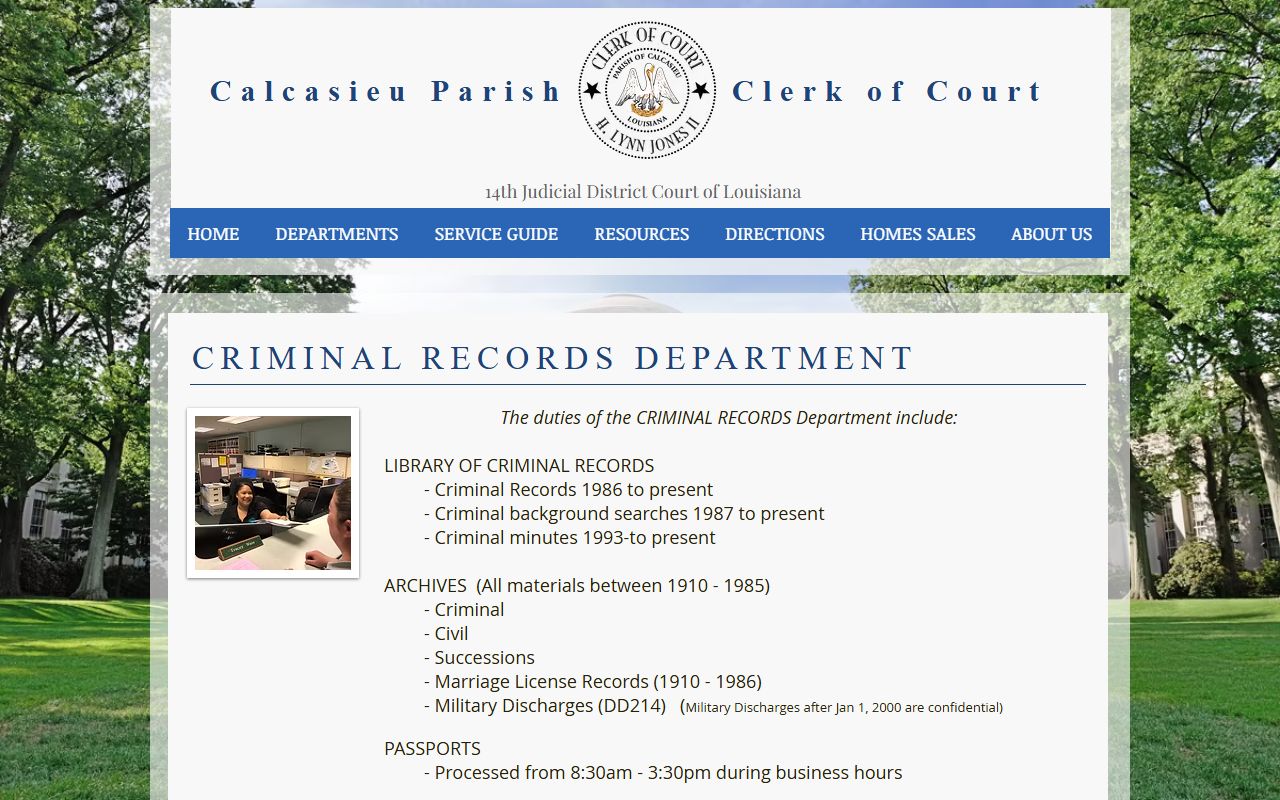
Those Clerk categories help separate jail custody records from the formal criminal case record.
Charges After Jail Arrest
After a Calcasieu Parish arrest, the court record may be built from a complaint, information, or indictment. The exact document depends on the offense, prosecutor review, and court process. The DA's felony section assigns assistant district attorneys to court divisions and handles felony matters. The misdemeanor section processes misdemeanor criminal files, sets matters, and checks arrest and bond information before routing files to the proper court path.
| Document | Who Uses It | What It Does |
|---|---|---|
| Complaint | Law enforcement or prosecution process | States the alleged offense that begins or supports the case path. |
| Information | District Attorney | Formal prosecutor-filed charge document, often used after review. |
| Indictment | Grand jury process | Formal charge returned through grand jury action, often for serious felony matters. |
Calcasieu Parish Charge Status
Charge status is the reason court records after a jail arrest can look different from the roster. A roster may show the arrest or booking charge as first entered. The court case may later show a filed charge, amended charge, reduced charge, dismissal, nolle prosequi, plea, verdict, or other disposition. "Disposition" means the current or final result of a charge. "Nolle prosequi" means the prosecutor declines to pursue or dismisses a charge.
| Status | What It Means |
|---|---|
| Pending | The charge remains open and has not reached a final court result. |
| Amended or reduced | The prosecutor or court record reflects a changed charge from the initial allegation. |
| Dismissed | The charge is no longer being pursued in that case, subject to the exact order language. |
| Nolle prosequi | The prosecutor declines or dismisses the charge through the DA's authority. |
| Convicted | A plea or verdict resulted in a conviction on that count. |
DA Records After Arrest
The Calcasieu Parish District Attorney public-records page gives a separate path for prosecution records and disposition letters. Disposition letters are free. Public records cost $1 per page. Videos cost $15 for the first disc and $10 for each later disc. Requests must be in writing on the DA forms and may be returned by mail or email. The office states it responds within five days, and accepted payment is money order or law firm check. Unpaid invoices close after 30 days.
| DA Item | Cost or Rule | Use |
|---|---|---|
| Disposition letter | Free | Confirms prosecution disposition information. |
| Public-record copies | $1 per page | Written request for prosecution records. |
| Video disc | $15 first disc, $10 each later disc | Video records requested from the DA. |
| Payment | Money order or law firm check | Used for DA fees listed by that office. |
The DA page is not a jail mugshot shortcut. It is for prosecution records and disposition requests after the case has moved beyond the roster stage.
Bond, Warrants, and Arrest
Bond records can sit between jail custody and court case history. CPSO Court Records & Bonds processes criminal bonds taken in Calcasieu Parish and notifies defendants and bondsmen. The DA divisions page adds a key failure-to-appear detail: when a defendant misses court, a personal surety or commercial bondsman has 180 days or six months to locate the defendant and bring the person to court. A missed court date can also lead to a bench warrant, which may show in court minutes before a new jail booking appears.
| Term | Plain Meaning |
|---|---|
| Cash bond | Full cash amount posted with the court or jail process. |
| Surety bond | Bond posted through a licensed bail agent or surety. |
| PR bond | Release based on a promise to appear. |
| No-bond hold | Payment alone will not release the person. |
| Bench warrant | A judge-issued warrant, often after failure to appear. |
No official CPSO public active-warrant database was located in the inspected pages. For a possible warrant, use court records, official agency contacts, and counsel where needed. Do not rely on rumor or third-party lists.
Charges vs Convictions
Calcasieu Parish court records after an arrest can show allegations long before any conviction exists. A charge is the accusation or filed count. A conviction is a court result after a plea or verdict. This distinction matters for employment, housing, licensing, and personal decisions because an arrest, a charge, and a conviction carry different legal meanings.
| Point | Charge | Conviction |
|---|---|---|
| Stage | Accusation or filed count | Final result by plea or verdict |
| Proof level | Lower than trial proof | Beyond a reasonable doubt or valid plea |
| Can change? | Yes, it may be amended, reduced, or dismissed | May be appealed, set aside, or later expunged if eligible |
Sealed and Expunged Records
Louisiana public-records law starts with broad access, but criminal records can be limited by active-investigation rules, court orders, juvenile confidentiality, and expungement. Louisiana R.S. 44:1 defines public records broadly. Title 44 and R.S. 44:3 context address law-enforcement and prosecution records limits. Code of Criminal Procedure art. 971 says expungement removes eligible records from public access but does not destroy them.
| Point | Sealed | Expunged in Louisiana |
|---|---|---|
| Public view | Hidden from ordinary public access by order or law | Removed from public access for eligible records |
| Record existence | The record still exists | The record is not destroyed under art. 971 |
| Route | Court order or confidentiality rule | Louisiana expungement process through the court |
For statewide personal criminal-history review, Louisiana State Police provides a Right to Review process under R.S. 15:588. That is separate from a Clerk case search or DA disposition request.